
New London County Sources for Previous Residents
A backward address search works best as an era map. Current parcel data can identify the legal lot and a person tied to tax records, while town-clerk instruments show conveyances. Directories, census material, newspapers, Sanborn maps, permits, probate, and archival indexes then add household or neighborhood context. Each source answers a different question, so the table keeps ownership, occupancy, building history, and family evidence separate.
| Source | Years It Covers | Where Held | What It Shows |
|---|---|---|---|
| Municipal assessor or VGSI | Current grand-list cycle; 2023 revaluation context | Assessor and parcel portal | Parcel, owner or taxpayer, situs, mailing, assessment date |
| Town-clerk deed index | Town-dependent; no countywide web cutoff verified | Applicable clerk, RecordHub, older books or microfilm | Grantor, grantee, instrument, book/page, legal description |
| New London City Directories | Beginning 1853 | PLNL, NLCHS, selected ECSU holdings | Dated household or business address entries |
| Norwich City Directories | 1846-1986 | Otis Library | Regional name, address, and occupation comparisons |
| New London Day | July 1881-present at PLNL | New London Public Library microfilm | Obituaries, notices, events, and address clues |
| New London Sanborn material | 1912 identified | PLNL and regional map collections | Building footprints, uses, and street context |
| Federal census | 1790-1930 access holdings; later records follow the 72-year rule | Libraries, archives, and federal resources | Household relationships, age, occupation, and enumeration place |
| Probate and court | Probate online dependable mainly 2011-present; older incomplete | District court, State Library, or Archives | Fiduciaries, heirs, estate actions, and legal names |
| Building or code file | No fixed public online run located | Building Division or FOIA request | Work, inspection, applicant, or contractor when released |
Start with the source closest to the question. Use the assessor and deed index for a parcel chain, a directory or census for a household, the newspaper for a death or move, and probate for heirs or fiduciaries. When the online trail stops, ask the responsible town, library, court, or archive for the next book, reel, file, or finding aid.
Note: A prior owner, listed householder, mailing recipient, and occupant are different relationships and should never be merged without a second source.
New London House History Starts at Parcels
The current parcel is the safest starting point for previous residents because an address can be spelled more than one way. The New London VGSI assessment database gives the city property route and says values reflect 70% of fair market value as of the October 1, 2023 revaluation. Its dynamic card is expected to expose a parcel identifier, owner or taxpayer, situs, mailing address, land and building values, and possible sketch or exemption fields. Exact labels still need live confirmation.
Record the assessment date and keep the situs address apart from the mailing destination. A tax mailing address can point to another town or state, but it does not prove that the owner lives at the parcel. An occupant, caretaker, business, trustee, or estate may not appear on the card. Use the New London MapGeo viewer to orient the parcel, compare its shape with nearby lots, and note any historic or planning layer without treating the map as a survey.
Tracing New London County Previous Residents
Connecticut has no county recorder for New London County. The town or city clerk holds the land record for the municipality where the parcel sits. Under CGS §7-25, town indexes use grantor and grantee names with the nature and date of the instrument, book and page, and location. Start with the current parcel, then treat each seller as the next historical search name.
The representative Cott deed-index search shows the kind of workflow available on a selected town site: search term, date range, document type or number, image search, and index-only or index and OCR options. It is a Deep River system example, not a New London County result, so it demonstrates the interface rather than local coverage.
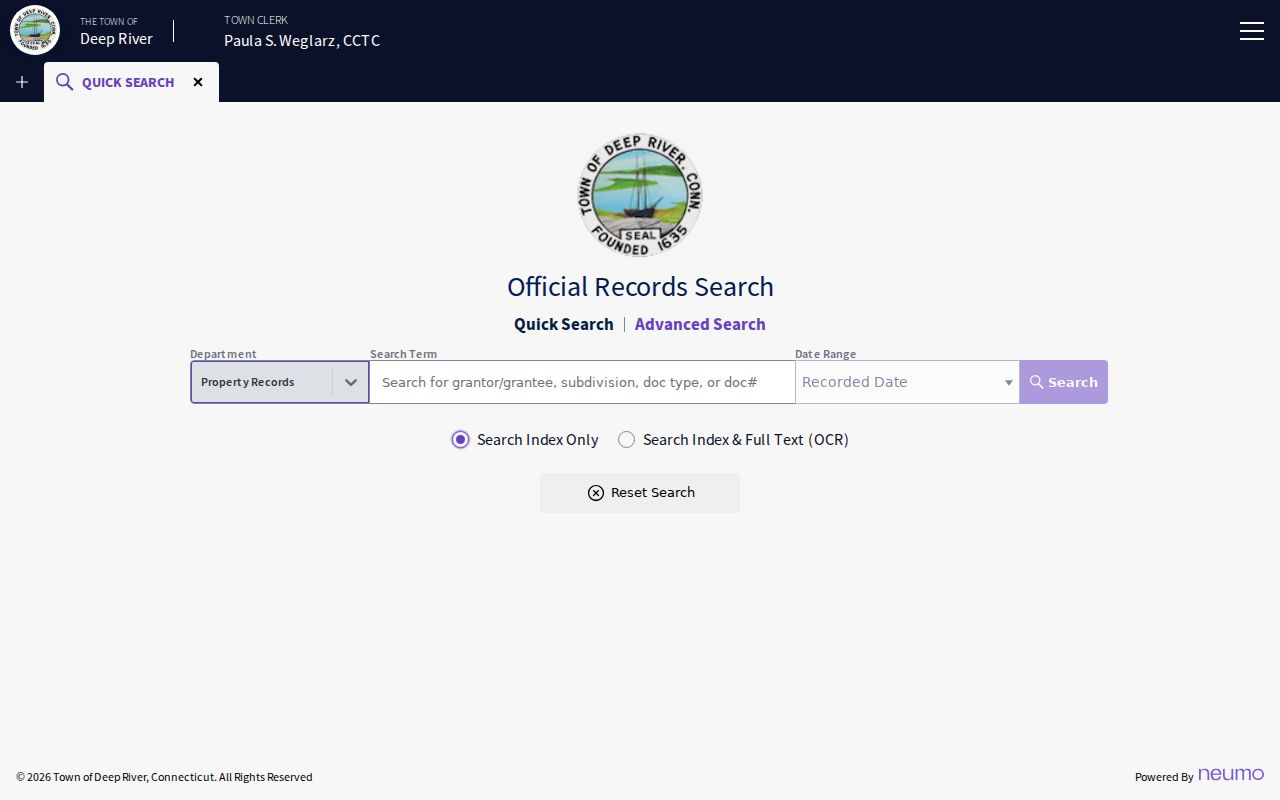
The Cott example helps explain why a grantor, grantee, book/page, legal description, and image indicator should be copied together. A local New London County record must still be pulled from the correct town site or clerk.
- Copy the parcel identifier, situs, owner or taxpayer, mailing address, assessment date, and legal-description clue.
- Search the current owner as grantee in the applicable town-clerk index and record the latest deed, book/page, or instrument number.
- Read the deed for the grantor, legal description, recording date, and any prior book or map reference.
- Search that grantor as grantee for the preceding conveyance, then repeat while checking names of trusts, estates, or entities separately.
- When the web result ends, ask the town clerk for an earlier deed book, index, microfilm record, or certified copy.
- Grantor and grantee
- The grantor transfers an interest. The grantee receives it in the recorded instrument.
- Chain of title
- The linked sequence of recorded transfers for one parcel or legal description.
- Legal description
- The lot, map, subdivision, or boundary wording that can keep an old record tied to land after a street name changes.
New London Clerks After 1960
New London County was constituted in 1666, but Connecticut did not develop a county recorder or county seat for land filings. County government ended in 1960. The practical route is therefore municipal: select the town first, then use its clerk, assessor, registrar, library, or court. A county-level deed search can hide the older book that actually holds a parcel’s history.
Cott RecordHub provides a shared landing page for participating town sites, including Bozrah, Griswold, Groton, Montville, Old Lyme, and Stonington. A distinct New London city URL was not exposed in the public selector. The New London Land Records page gives the city clerk route, including in-person recording through 3:45 p.m. and weekday office access. Index, image, subscription, and certification rules vary by town.
The legacy Connecticut Town Clerks Records login shows User ID and Password fields, account help, index-only guest access, and paid image options. Its captured historical notice listed 24-hour access at $7.50 per day, $35 for 30 days, images at $1 per page, and a 5% PayPal service fee for watermark removal, printing, or downloading. Treat those prices as a historical notice and verify them before payment.
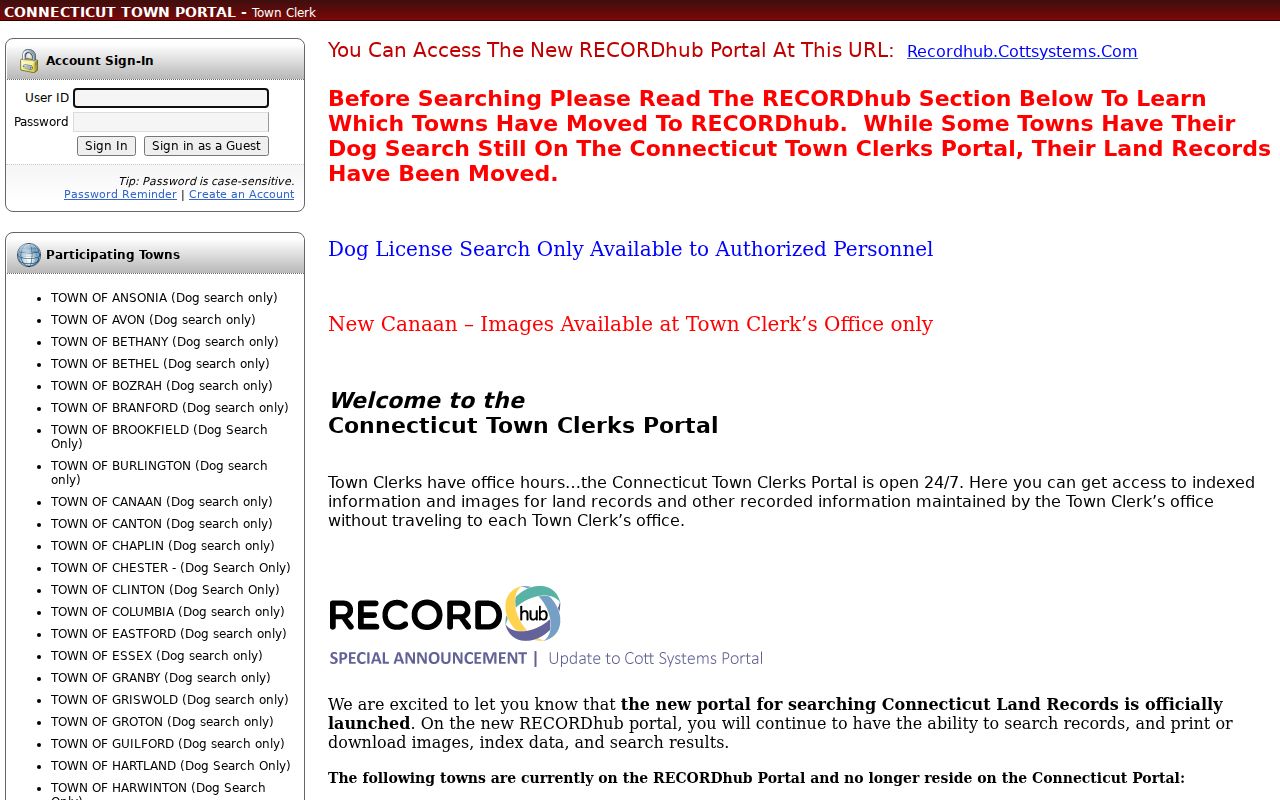
The login screenshot marks an access path, not a local deed result. When a subscription screen blocks the needed image, the fallback is the responsible town clerk, an older book or microfilm request, or a certified-copy request with the parcel and book/page in hand.
Pairing New London Directories with Census
Ownership and household history are different trails. New London City Directories begin in 1853, Norwich directories at Otis Library run from 1846-1986, and Mystic directories in the ECSU regional collection cover 1912-1932. PLNL holds New London Day microfilm from July 1881 to the present and identifies 1912 New London Sanborn material. Federal census access holdings cover 1790-1930, while later records follow the 72-year rule.
The collections themselves are described on the New London County Directory Book. A directory can show a listed name and address between census years, while a census can add household relationships and age. A Sanborn sheet can explain a building footprint without naming every occupant.
- Write down the exact street and town from the deed or directory before choosing a census district.
- Find the closest directory year and copy the name, address, occupation, and page.
- Compare the same household in the available census period, allowing for street spelling and enumeration changes.
- Use the next directory or newspaper run to test a move, death, boarder, or new household.
- Keep the deed, directory, census, map, and newspaper citations as separate evidence lines.
New London House History at Libraries
The New London Public Library Local History and Genealogy Room accepts specific questions by appointment at 63 Huntington Street, New London, 860-447-1411 extension 5. Connecticut residents pay no research fee under the posted policy; out-of-state researchers pay $25. Give the room a person, source, page, date, or event. Its directories, newspapers, maps, family genealogies, school publications, Sanborn material, and town histories are suited to an address trail.
The New London County Historical Society works by appointment at the 1756 Shaw Mansion through Research@nlchs.org or 860-443-1209. Its property transactions, wills, tax material, historic maps with owners, family papers, civic minutes, directories, newspaper indexes, and WPA headstone notebooks can supply the next link when a deed names an estate or a directory line is too short.
The PLNL research-room source shows the human route for a house question when no standalone county house-history guide is available.
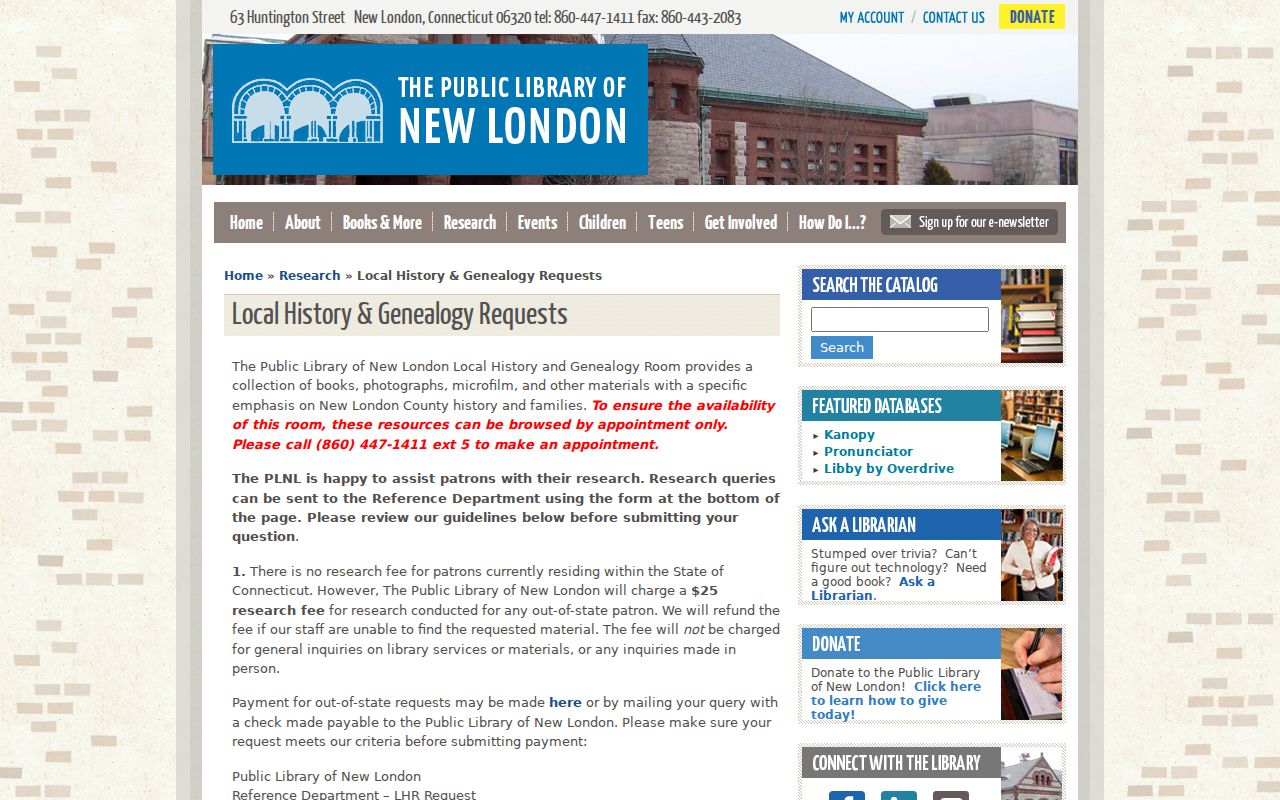
The library image connects an address search to a real appointment-based collection. A focused request can test a directory line, newspaper notice, map, or family paper without assuming that a blank web result closes the trail.
The Preston Hamilton New London Address Trail
The official Preston Hamilton heritage page models how previous residents can be studied without treating one directory line as a complete biography. The page identifies Hamilton in the 1876 New London city directory advertisement on page 15, describes him as a maker of church organs, and connects the entry to Union and Golden Streets, estate material, and a Cedar Grove burial reference.
The research sequence is clear: cite the directory page, verify the street and town, compare a map or deed, search the newspaper, then use probate or burial material where the public record supports it. The official William and Celinda Harrison page uses a 1853-54 directory entry on page 18 and follows deeds, an obituary, address changes, demolition decisions, and urban renewal. The result is a documented address trail, not a guessed list of household members.
Shapley Street and New London Gaps
Shapley Street is a local warning against matching old and new addresses by name alone. The documented story places the street’s disappearance in the 1960s Winthrop Cove urban renewal period. A historic directory, deed, newspaper, map, or demolition record may refer to the old street while a current parcel map does not.
The exact conversion from every Shapley Street address to a modern address remains a research gap in the reviewed sources. Search the historic street name, nearby cross streets, legal description, map owner, and newspaper wording. If no official bridge is found, label the uncertainty instead of forcing a modern location onto a past resident.
New London Past Households and Obituaries
Previous residents are often visible first as a named household, subscriber, business, or boarder, not as the person on a deed. Read the directory address, then check the New London Day microfilm, Norwich newspapers, NLCHS indexes, school annuals, or family papers for a death, marriage, move, or civic event. The newspaper run at PLNL begins in July 1881, while NLCHS identifies county newspaper marriage and death indexes from 1758-1866 and a regular newspaper series through 1904.
Probate can close a household trail by naming a fiduciary or heir, but online probate coverage is dependable mainly from 2011 to the present and older material can be incomplete. Use the New London or Niantic probate district, the State Library, or the Archives for older material. An obituary may name a spouse, child, church, funeral home, or later address. Confirm that relationship with a vital, court, directory, or deed source before treating it as proof about the historic property.
Lawful use. Previous-resident research in New London County is for house history, family history, civic curiosity, and personal record work. Do not use names or addresses to stalk, harass, or track a living person, and stop when a source is protected.
Marking a New London County Research Gap
No authoritative New London County-wide imaging cutoff year was located for town land-record portals. No standalone official county house-history guide, countywide cemetery finder, or public indexed New London permit run was verified either. Those are gaps to record, not invitations to fill in a missing year or invent a county office. The county’s history is decentralized among town clerks, municipal offices, libraries, historical collections, courts, and archives.
When an online record ends, send a narrow request to the office that holds the record. Name the municipality, address or parcel, record type, date range, attachments, and preferred electronic format. Connecticut FOIA under CGS Chapter 14 can reach existing public records subject to exemptions, but it cannot require an agency to create a new resident list. A clerk, librarian, or State Archives archivist can often identify the next book, reel, finding aid, or appointment route.
Keep the last confirmed date, town, source URL, and unresolved question with the house file. That handoff protects the difference between a genuine missing record and a search that stopped at the wrong custodian.