
New London County City Directory Holdings
New London County has no single historical people index. Its city directories, newspaper runs, telephone books, maps, and family materials sit with several custodians, each setting its own years and access rules. The first local New London run begins in 1853. Norwich offers an older and longer regional comparison. Mystic volumes add a coastal-town angle. The table separates a dated directory entry from related sources that help explain an address or household.
| Collection | Years | Where Held | Access |
|---|---|---|---|
| New London Directories | Beginning 1853 | PLNL, NLCHS, selected ECSU holdings | Appointment or research access |
| Norwich Directory Volumes | 1846-1986 | Otis Library, Norwich | Genealogy room or research service |
| Mystic directories | 1912-1932 | ECSU Center for Connecticut Studies | Appointment |
| New London Day microfilm | July 1881-present | New London Public Library | Appointment and specific query |
| New London telephone directories | Jan./July 1929-Oct. 1934 | Library of Congress | Digitized image gallery |
These collections complement each other rather than substitute. A printed directory may name a householder or business. A newspaper may supply an obituary or notice. A telephone volume may omit a household entirely. No complete countywide year-by-year run exists. A missing volume should point to another named collection or a town-specific record request. Neighbors and past residents often surface across several record types at once. That cross-check is what makes a residents directory entry solid.
Note: A directory entry dates a person or business to publication time. It does not by itself prove a current home.
New London County Directory Research at PLNL
The New London Public Library Local History and Genealogy Room sits at 63 Huntington Street in New London. Call 860-447-1411 extension 5. Appointments are required. Connecticut residents pay no research fee under the posted policy. An out-of-state researcher pays $25. A useful request names a person, source, page, date, or event. Broad requests, or work aimed at monetary gain, can be declined.
This room anchors a New London directory search. Its volumes begin in 1853. New London Day microfilm runs from July 1881 to the present. Family genealogies, school publications, town histories, the 1912 New London Sanborn material, American Genealogical Biographical Index resources, selected Barbour material, and Black Roots in Southeastern Connecticut add context. They help when a directory entry runs brief.
The library collection description shows why a specific query matters. Staff can search a dated newspaper or directory run. They cannot promise a complete answer from a vague name alone.
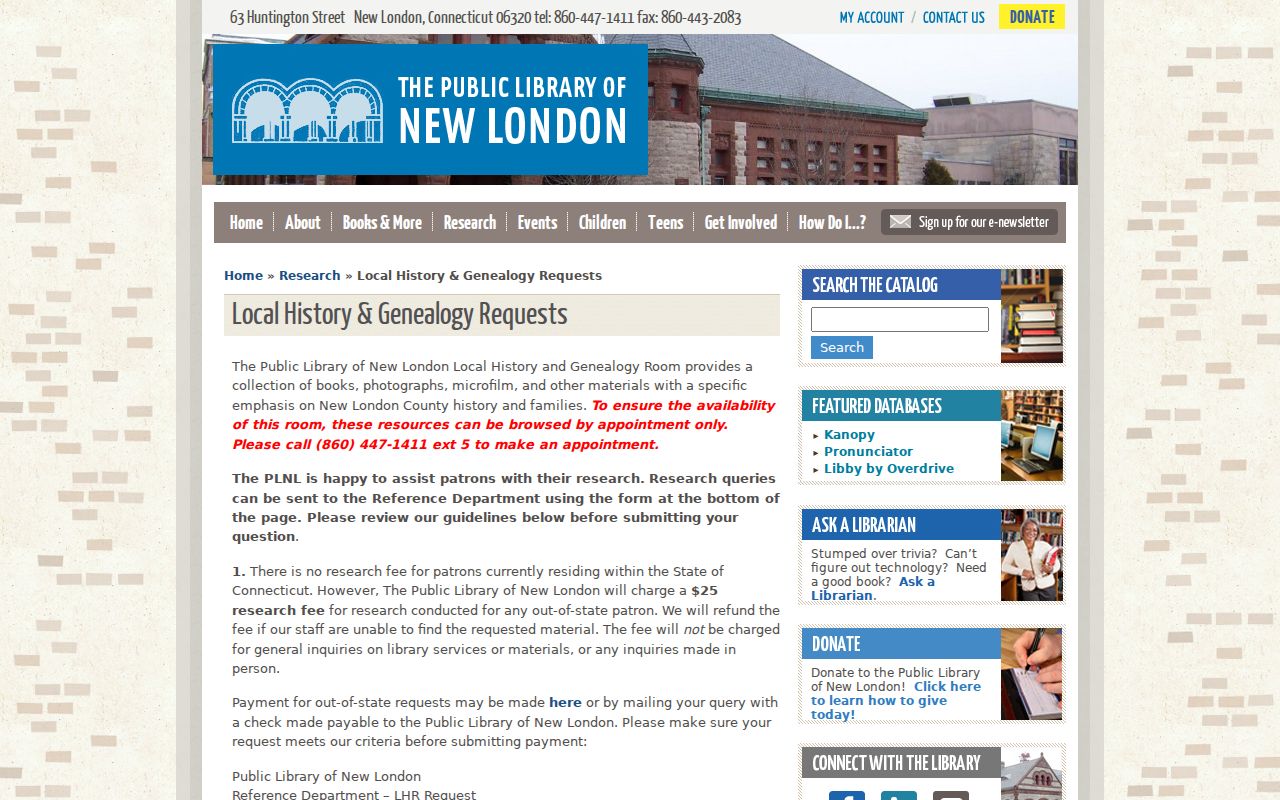
The PLNL research-room view points to a human-assisted route, not an instant countywide lookup. Hand the librarian an exact name, street, and period. Then ask which volume or microfilm sequence can test it.
Norwich Directories Extend New London
The Otis Library at 261 Main Street in Norwich keeps Norwich city directory volumes covering 1846 through 1986. Beyond the street directories, the shelves hold family genealogies, town histories, Norwich vital indexes, Barbour and Hale material, Norwich Free Academy yearbooks, cemetery and obituary abstracts, census microfilm from 1790 through 1920, and regional databases. These holdings earn their keep whenever a New London County name surfaces in Norwich records or a family drifted inland.
Newspapers fill out the picture. The microfilm collection carries the Norwich Packet from 1773-1802, the Norwich Courier from 1802-1858, and the Norwich Bulletin from 1858 through April 1951 plus 1983-2018, with bound volumes covering 1951-1982. New London Day runs from 1998 to 2022. Staff assist with searches, readers, scanners, printers, and copies.
A free quick lookup covers simple questions. Work beyond 15 minutes costs $10 for up to two items, extra items run $5 apiece, digital delivery is free, and hard copies cost 25 cents per page plus packing and postage. Send requests to ref@otislibrarynorwich.org or call 860-889-2395, with each patron limited to two hours per month.
New London County Regional Directory Checks
The Eastern Connecticut State University Center for Connecticut Studies occupies 83 Windham Street in Willimantic. Access is by appointment. Its regional holdings include New London directories from 1902-1935, Norwich directories from 1861-1960, and Mystic directories from 1912-1932. Maps, atlases, Sanborn material, newspapers, census records, Barbour material, and Hale records round out the shelves. Together they help test whether a name moved between a city, village, and town.
The Library of Congress also offers New London White and Yellow Pages images for January and July issues from 1929 through October 1934, totaling 628 microform images. A telephone directory is not a legal residence roll. It may omit an unlisted household. It may shorten a name, or show a subscriber rather than every person living at the address. So treat phone volumes as clues, not proof.
New London County Historical Society Research
The New London County Historical Society works from the 1756 Shaw Mansion, and visits run by appointment. Holdings run deep. New London directories survive from 1853, alongside wills, deeds, tax material, ship registers, and family papers. Maps mark owners. Photographographs and school annuals round out the shelves. Email Research@nlchs.org or call 860-443-1209 before counting on any manuscript, map, or newspaper file.
Newspapers begin with a 1758 photostat. Coverage stays uneven until the mid-1800s. A regular series then runs through 1904. The genealogy collection also holds WPA headstone notebooks for each county town, plus marriage and death indexes from county newspapers covering 1758 through 1866. Together these sources can tie a directory name to a family relationship, a property transfer, or a burial clue. A short entry is never a full household list.
The society collection page helps most when a New London directory entry needs local context, so ask for the exact family, address, organization, or date in advance.
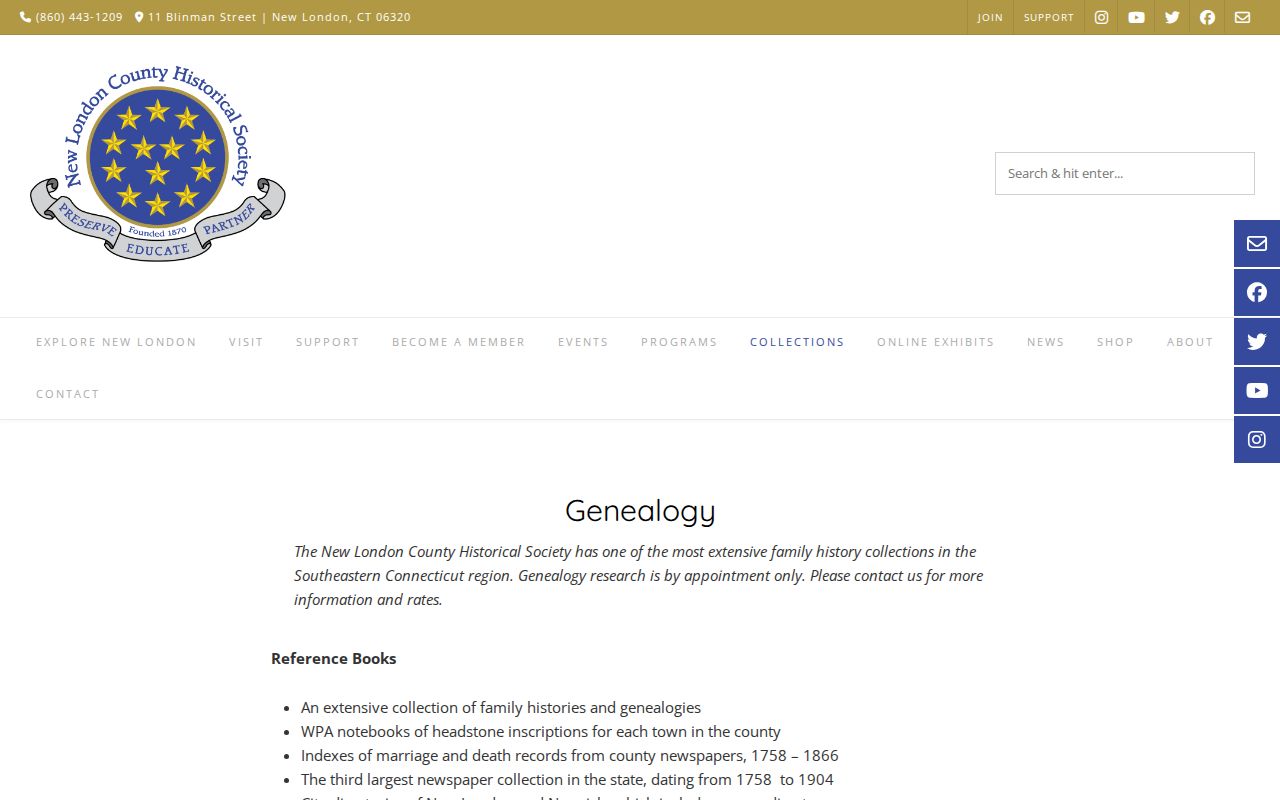
Deeds, maps, newspapers, and family papers sit behind a single directory shelf. Together they can confirm a printed address. The society's appointment system is the way in, since none of this material lives on a public web index.
Reading New London County Directories
Copy each entry exactly first. Record the printed name, page, street, town, occupation, and any household or business wording. Abbreviations matter. One abbreviation can change a line's meaning. A New London directory entry might describe a head of household, a boarder, a business, or a telephone subscriber, and it may not list every person at the address.
| Name | Copy the spelling, initials, married name, or business name as printed. |
|---|---|
| Occupation | Record the trade or role only when the volume states it. |
| Address | Capture the house number and street, then compare the place with a period map. |
| Household clue | Note a spouse, family member, boarder, or widow notation only if printed. |
| Owner or residence mark | Check the volume's key for an ownership or other residence-status symbol before interpreting it. |
- Criss-cross directory
- A street-order or address-order section, when a volume includes one, used to move from a place to a name.
- Householder index
- A name-to-address aid that usually points to the primary listed person, not every member of a household.
- Abbreviation key
- The volume's explanation of short forms and marks. Find it before expanding a line.
The 1876 New London Directory Trail
The Preston Hamilton heritage page shows a clean directory citation. It points to an advertisement on page 15. Hamilton appears there as a maker of church organs. The printed entry then connects to Union and Golden Streets, an estate trail, and a burial reference at Cedar Grove. The value is not one isolated name. It is the chain from page to map, address, estate, and burial evidence.
The William and Celinda Harrison page works the same way. It cites the 1853-54 directory at page 18. From there it follows deeds, an obituary, address changes, demolition decisions, and the loss of Shapley Street to urban renewal. Both examples model the habit worth copying: cite the year and page first, then test the address against another record.
New London County State Archives Indexes
State Archives indexes add depth beyond a city directory. The New London County African American Collection covers 1701 through 1854. A Native American Collection spans 1698 to 1855. Superior Court record indexes reach from 1874 to 1974. The online entries are starting points. Originals and finding aids sit in Archives research areas and may require a request.
For access help, contact CSL.ISREF@ct.gov or 860-757-6580. Search the exact name and record series, then ask for the original, finding aid, or reproduction path. These indexes do not replace PLNL, Otis, NLCHS, or ECSU; they add a second custody line when a directory entry points toward court, community, or family history.
New London County Directory Timeline
The New London County record grew from many separate starting points. That is why it feels layered, not centralized. Treat the dates below as anchors for choosing a collection rather than proof that every year in between survives.
- 1666: New London County was constituted, with records developing through towns and local custodians.
- 1846: Norwich directory volumes begin the long Otis Library comparison run.
- 1853: New London directory volumes begin in the documented local collections.
- July 1881: The New London Day microfilm run begins at PLNL.
- 1912: New London Sanborn material is identified at PLNL.
- 1929-1934: The Library of Congress telephone directory image set covers New London White and Yellow Pages.
- 1960: Connecticut county government ended, leaving town clerks and other local custodians as the practical route.
No definitive official account of a New London County courthouse fire or countywide record loss exists. A blank result is not proof. Read it instead as a question of coverage, access, or protection, never as evidence that a person or event never existed.
Family History in New London Directories
Date every entry. Record the town or street with it. Spellings change. A family can vanish for a year or move from New London toward Norwich, Mystic, or another county town. When the goal is one address and its past occupants, the New London County previous residents search pairs the directory shelf with deeds, maps, newspapers, and probate.
- Choose a person, family, address, or event and set a date range.
- Copy the exact name, page, street, occupation, and printed relationship from the first volume.
- Check nearby directory years, then pair the entries with the available census period or a newspaper notice.
- Use a map, deed index, or town record to test whether the street and municipality match.
- Ask PLNL, Otis, NLCHS, ECSU, or the State Archives for the next documented source when the run stops.
People vanish from directories. The reason may be a move, a death, or an unlisted household. It may also be a business change or a missing volume. Each leaves a paper trail. Deeds, obituaries, probate files, or school annuals can separate them. A later directory helps too. Keeping the printed entry, source date, and record relationship together keeps a historical snapshot from being mistaken for a current residence.