
How New London Residents Are Found
New London County is a network of 21 towns, not a single county records office. Start by identifying the municipality tied to the address or event. A New London assessor can connect a parcel to an owner or taxpayer. The Connecticut voter lookup can test a named person in a selected town. A town clerk holds the deed trail. Libraries and archives add the older household record. Each source answers a different question, so the result should be labeled by its relationship, date, and custodian.
A practical search moves from a broad lead to a primary record. It can locate an owner, voter registration, party to a case, fiduciary, license holder, historical subscriber, or former household. It cannot turn one name into proof of current occupancy. Protected addresses, unlisted people, visitors, and household members may never appear in a public result.
- Resolve the address to a legal town with the USPS address tool, then confirm the parcel in municipal GIS or the assessor system.
- Search the New London VGSI assessment database or the relevant town assessor for owner, taxpayer, situs, mailing, and parcel clues.
- Use the Connecticut voter lookup by town and name when registration status or polling place is the question.
- Search the applicable town clerk’s grantor and grantee index for a deed, lien, mortgage, or trade-name connection.
- For older people or missing online records, ask the library, historical society, archive, or custodian for a narrow date-and-source search.
New London Record Custodians
There is no New London County clerk, recorder, or register of deeds. Connecticut ended county government on October 1, 1960, and town clerks remain the land-record custodians. New London City Clerk handles city land, vital, election, and public-record services at 181 State Street. Other addresses route to the clerk for Bozrah, Groton, Norwich, Stonington, or the specific town involved. The Connecticut State Library town table is the safest way to confirm the county’s 21-town frame.
The assessor describes property, not a household. The voter lookup describes a registration record, not a street roster. The Judicial Branch and probate courts have their own districts and access rules. When a routine record is not online, Connecticut’s Freedom of Information Act, CGS Chapter 14, routes a focused request to the agency that actually keeps it.
Town and City Clerks
Land instruments, trade names, local vital and election records
New London City Clerk: 860-447-5205
New London Assessor
15 Masonic Street, New London, CT
860-447-5216
Connecticut Voter Lookup
Town, name, and birth-date verification
SOTS LEAD: 860-509-6100
New London Resident Sources Today
No single current directory contains everyone in New London County. These sources are useful when the question is stated precisely. An owner is not automatically an occupant, a mailing recipient is not automatically a resident, and a public meeting page is not a private membership list.
| Source | Who It Lists | Keeper | Access |
|---|---|---|---|
| Assessor / VGSI parcel card | Owner or taxpayer, situs, mailing | Municipal assessor | Public, informational |
| State voter lookup | Registration status, party, polling place | Connecticut SOTS and town registrars | Name-and-town form |
| Town-clerk index | Grantors, grantees, liens, trade names | Applicable municipality | Portal and image rules vary |
| Judicial and probate inquiry | Parties, case events, fiduciaries | Connecticut courts | Protected records omitted |
| Library and archive collections | Historical names, addresses, organizations | PLNL, Otis, NLCHS, ECSU | Appointment or research service |
Use a parcel record for property context, a voter result for a registration question, a court search for a case relationship, and a library source for a historical snapshot. The one-person workflow on the New London resident lookup page keeps those distinctions visible while comparing names and dates.
New London VGSI Parcel Search
The City of New London’s VGSI assessment database is a practical starting point when an address is known. The portal describes assessments at 70 percent of fair market value as of the October 1, 2023 revaluation. Read its result as municipal property evidence. Online values may not include exemptions or penalties applied to the final grand list, and the portal is not a tax-bill calculator.
Capture the owner or taxpayer, situs address, mailing destination, parcel identifier, land and building components, total assessment, visible exemptions, sketch fields, and the date of the result. The mailing destination can point to another town or state, but it is where tax correspondence goes, not proof that the named person lives at the parcel.
The live portal’s exact labels were not exposed in the research capture. That gap is a reason to save the result and contact the assessor at 15 Masonic Street or 860-447-5216 when a field needs confirmation.
The New London VGSI page is the clearest visual example of a property-led residents directory search.
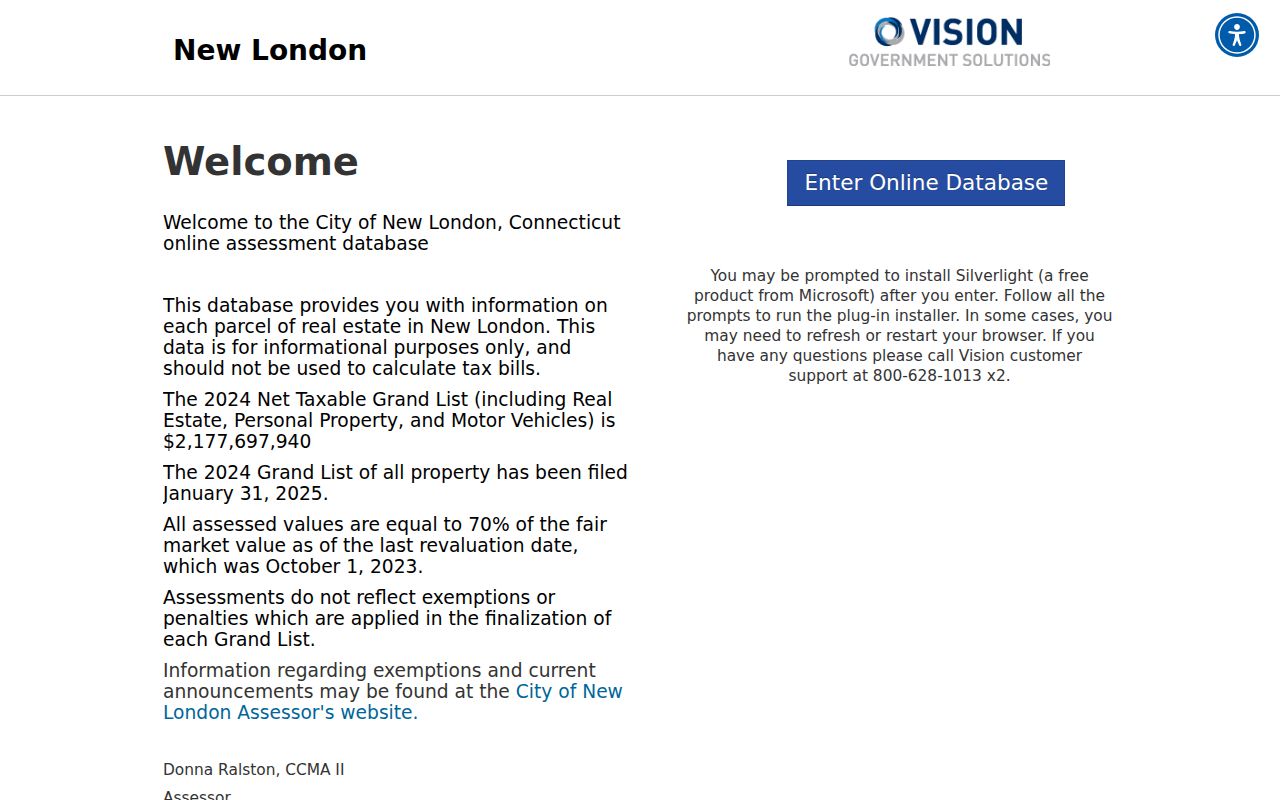
Use the parcel card as one dated source, then compare it with a town-clerk instrument, voter result, or historical source before describing a person as connected with an address.
The New London Voter Lookup
The Connecticut Secretary of the State voter lookup is a person-and-town check, not a countywide street roster. Choose a town, enter a last name, and add a first name or date of birth in MM/DD/YYYY format when helpful. A match can show registration status, party, polling place, and related election fields. Date the result because status can change.
Only the birth year is public under Public Act 26-1, §96. Birth month and day are protected in the public display. A full voter file is a separate CSV-only request to SOTS LEAD, listed at $300, with an allowed election, scholarly, journalistic, political, or governmental purpose. Personal, marketing, display, reproduction, harassment, and intimidation uses are barred. A residents directory should use the individual form instead of building a block list.
| Field | What to know |
|---|---|
| Town | Select one municipality; there is no New London County option. |
| Last name | Required in the public form; spelling changes the match. |
| First name | Optional, but useful for same-name results. |
| Date of birth | Use MM/DD/YYYY when known; public output limits the date. |
The public voter form shows why a blank result is not a negative finding. Town choice, spelling, inactive status, timing, or a confidentiality program can change the outcome.
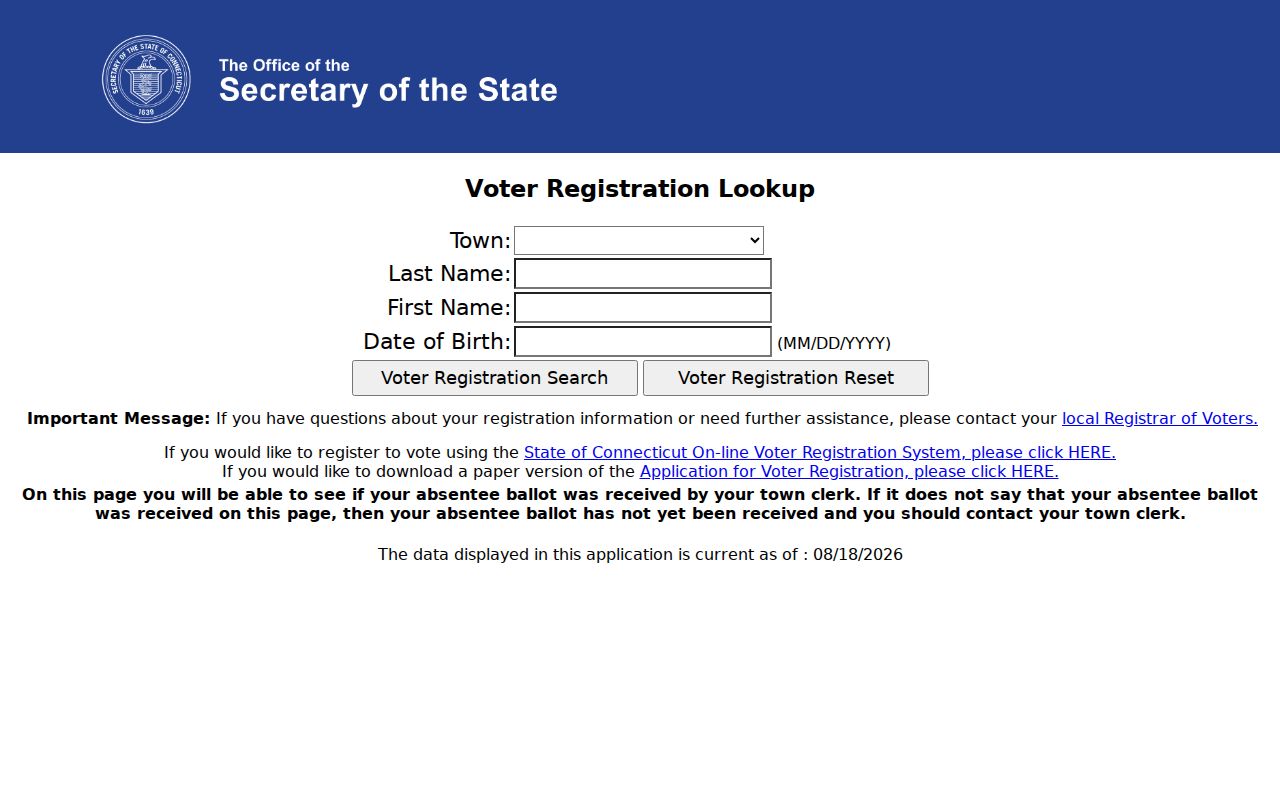
Check the source relationship directly. A registration match does not prove title, occupancy, mailing receipt, or presence on a particular day.
New London Address-to-Name Trail
When the starting clue is a street, keep the path in order: standardized postal address, legal municipality, parcel card, recorded instrument, and only then a person-centered source. The USPS ZIP Code Lookup can validate the street, unit, city, state, and ZIP. Municipal GIS can connect the postal form to a parcel, but a postal label does not establish the town that holds the deed or vital record.
New London MapGeo supports Property Quick Search, Selection, Themes, Markup, Abutters, Zoom To, Share, and Print. SECOG adds regional 2D and 3D layers, map or survey search, abutters, and mailing-list creation. Both maps carry informational limits. A parcel outline is not a survey, and an abutter result is a parcel set, not a people roster.
Connect the parcel to the town-clerk index under CGS §7-25. Search the owner as grantee, record the grantor and book or page, then search the grantor as an earlier grantee. Cott RecordHub serves several towns, but New London County has no single online deed cutoff. If the portal stops, ask the clerk for the earlier book, microfilm, index, image, or certified copy.
- Situs address
- The mapped location of the parcel.
- Mailing address
- Where the assessor or tax collector sends notices.
- Legal description
- The deed’s lot, map, subdivision, or boundary language.
- Grantor and grantee
- The transferor and recipient named in a recorded instrument.
The address trail can reveal an ownership relationship without proving who occupied the property. Keep those labels separate in every residents directory note.
ZIP Clues and New London Town Lines
ZIP codes help narrow a search, but they do not replace a legal town. Mystic is a village in both Groton and Stonington. Pawcatuck is a postal label associated with Stonington. A New London County ZIP code directory therefore needs a municipality step before a town clerk, assessor, registrar, or court is selected.
USPS offers By Address, By City and State, and Cities by ZIP. Use the full street and unit when possible. The Secretary of the State post-office list includes 06320 New London, 06340 Groton, 06355 Mystic, 06379 Pawcatuck, 06388 West Mystic, 06389 Yantic, and many village, branch, station, and finance-unit labels. It also lists 06334 Bozrah and 06415 Colchester. Some entries are route clues, not separate civil governments.
A 2019 Postal Bulletin expanded delivery use of 06389 Yantic and 06334 Bozrah. That local history is useful when an old address and a current ZIP appear to disagree. Verify the full address with USPS, then use the municipal parcel and clerk record for the legal trail. The New London ZIP code directory carries the complete ZIP table.
New London Court and Probate Routes
The Connecticut Judicial Branch serves New London County through a judicial district, not a county court clerk. The Civil/Family inquiry offers By Party Name, By Docket Number, By Attorney or Firm Juris Number, and By Property Address. Party search accepts last name, optional first name, location, case category, case type, and Starts With, Contains, Is Equal To, or Sounds Like matching. Property search requires a town and can add street, ZIP, property type, and active, disposed, or all status.
Results can show the case name, type, docket number, file and return dates, court, last action or disposition, judge, party details, attorney information, motions, pleadings, and scheduled events. Web visibility varies after disposition. Juvenile, sealed, erased, protected-party, and other restricted records may be absent. A property-address case result is a lead, not proof of ownership or residence.
The Judicial property-address search demonstrates the address-capable route.
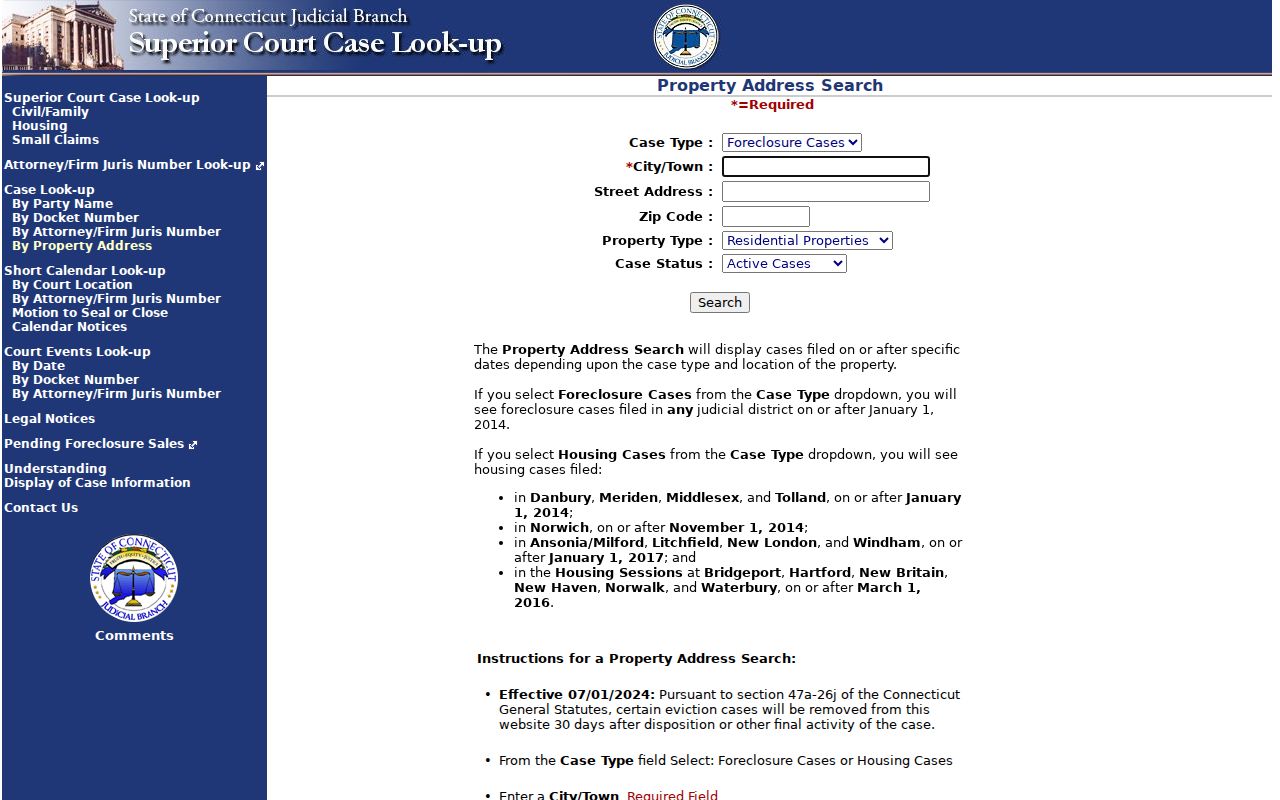
Probate is separate. The Probate Court case lookup accepts case type, district, status, first name, and last name. New London Probate is at 181 State Street, Room 2, and the Niantic Regional district covers East Lyme, Montville, Old Lyme, and Salem. Online decedent-estate and trust coverage is generally dependable from January 5, 2011 forward, with earlier material incomplete.
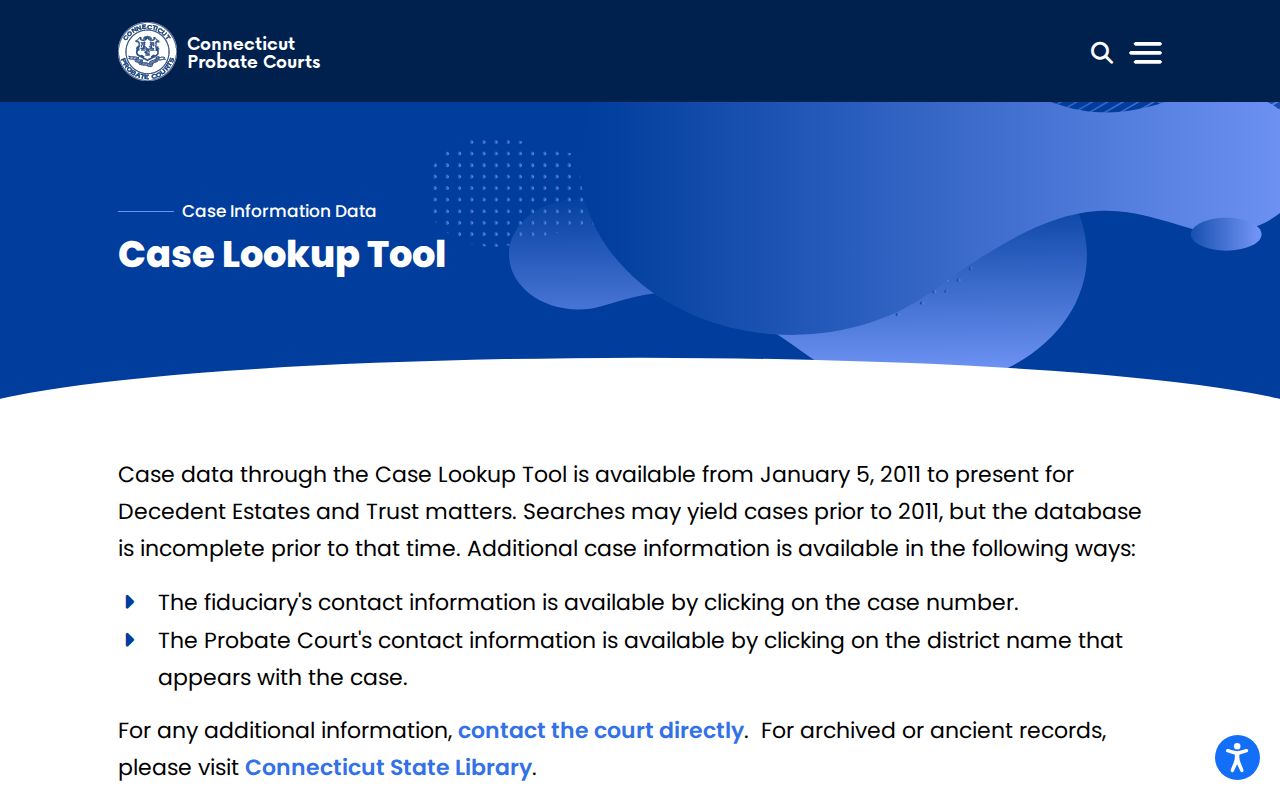
Use a court or probate hit for its exact relationship, such as party, fiduciary, or heir, and never collapse it into a current-resident claim.
New London Vital Records
Vital records answer event questions, not broad residence questions. The event town and Connecticut Department of Public Health can issue different copies. Birth records less than 100 years old are restricted under CGS §7-51. Births at least 100 years old become public. Death and marriage certificate access and Social Security number limits follow CGS §§7-51a and 7-74. Divorce decrees come from Superior Court rather than a town registrar.
For New London events, start with the New London vital-records page for identification, payment, mailing, and request instructions, then use the DPH Vital Records route when the state registry is the right custodian. A certified copy may require proof of eligibility. Genealogy access is not the same as unrestricted access to a recent certificate.
Keep event date, town, certificate type, eligibility, and source separate. A birth, death, or marriage record can confirm a relationship or date without proving that a person currently lives at a New London address.
Connecticut FOIA for New London Records
Connecticut’s Freedom of Information Act, CGS Chapter 14, §§1-200 et seq., gives access to records maintained by a public agency unless another law makes them confidential. It does not create a New London County records office. Send the request to the town clerk, assessor, police department, court, board, or other agency that holds the record.
A useful request names the town, address or parcel, record type, date range, attachments, and preferred electronic format. Ask for an existing index, file, or segregable copy rather than a new countywide list or a conclusion about who lives somewhere. Municipal copies are capped at 50 cents per page under the cited fee framework; certified copies are $1 for the first page and 50 cents for each later page, and prepayment may be required when estimated fees reach $10. Confirm current fees before sending money.
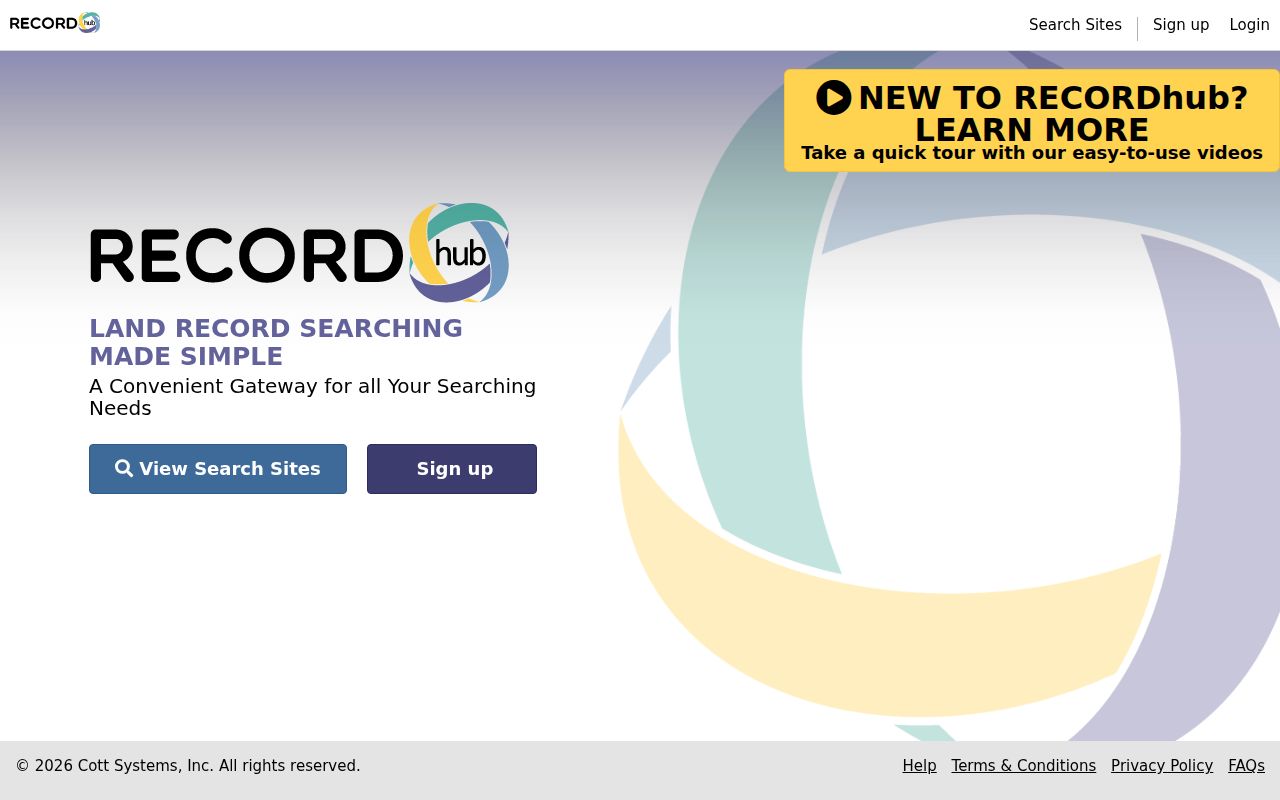
The Cott RecordHub landing page shows the shared portal model used by several towns, but a New London city URL was not exposed in the research capture.
If an agency withholds a record, ask for the statutory basis and segregable portions. A denial or qualifying failure to respond may be appealed to the Freedom of Information Commission. Protected voter fields, births under 100 years, Safe at Home addresses, juvenile matters, and law-enforcement exemptions still require separate analysis.
Historical New London Resident Directories
New London’s historical directory trail begins with city directories held at the Public Library and Historical Society from 1853. Otis Library’s Norwich run reaches from 1846 through 1986, while ECSU identifies New London, Norwich, and Mystic holdings. The Library of Congress adds New London telephone directories from 1929 through 1934. A printed entry can show a name, occupation, business, address, or telephone subscriber at a date, but it is not a complete residence roll.
For an old address, write down the exact year and page, then compare the street with a deed, map, newspaper, obituary, or probate file. The full collections, access rules, and sample entries are gathered on the New London city directory page. Older records are strongest when the town and source relationship remain explicit.
New London Search Terms and Limits
Official records and commercial search services are different kinds of evidence. A primary custodian can explain the record type, date, index or image, and correction path. A commercial service may combine public filings, directory material, purchased data, and address histories into a paid report. Such reports can be stale, merge people with similar names, or omit the source relationship.
| Source type | Strength | Use with care |
|---|---|---|
| Town clerk, assessor, court, or registrar | Named custodian and record relationship | Access limits, dates, redactions, and local coverage |
| Library, archive, or historical society | Exact year, page, newspaper, map, or manuscript context | Historical snapshot, appointment rules, incomplete runs |
| Commercial search service | May gather several public-source leads | Cost, stale data, merged names, unclear source and lawful-use limits |
A careful New London residents directory entry says what was found, where, when, and in what role. That short note is more useful than a bare name copied from an unmarked result.
New London Privacy Boundaries
Connecticut privacy law does not create a blanket deletion route for every public record. The Connecticut Data Privacy Act, Public Act 22-15, took effect July 1, 2023, and universal opt-out preference signals apply from January 1, 2025. The law excludes publicly available data in its definitions, so a town-clerk deed, court docket, or assessor card remains controlled by its government custodian. It can still matter to a covered controller that assembles or republishes data outside the original agency.
Safe at Home can substitute a mailing address and suppress a qualifying participant’s residential information. CGS §1-217 gives specified officials and public-safety or court-related people a protection route through the custodian. The federal DPPA also restricts DMV personal data. If a public result appears to expose protected information, contact the originating office and do not redistribute the address while seeking correction.
A blank result can reflect a protection program, erased or sealed court record, different town, spelling, or a portal coverage gap. It is not proof that a person or event never existed. Keep a source date and unresolved question for a clerk or librarian who can continue the search.
Records Changes to Recheck in New London
New London County’s record routes are changing in small, visible steps. The Secretary of the State’s July 10, 2026 release expects the GIS-based TotalVote replacement to go live in December 2026 after testing found roughly 4,700 district corrections and 1,600 “sliver district” records. That announcement concerns system quality, not a promise of a new public resident list. Recheck the individual lookup after launch.
Stonington’s July 13, 2026 PropertyCheck notice describes free text or email alerts for a name appearing in Stonington Land Records. It is name-only, not address or parcel-ID based, and it is not a New London County service. SECOG is working with municipalities on parcel and CAMA data consistency, while Connecticut DEEP is digitizing selected records. Neither development proves that every local record is online.
The strongest local habit is simple: resolve the town, use the official portal or collection, save the date, and check again when a state or municipal system changes.